Blogs & Articles
What you need to know about medical massage therapy, a career as a medical massage therapist, enhancing your knowledge as an LMT and much more!

Healing Happens Here: Supporting Christian Fox and Families in Crisis
On Saturday, September 24, 2022, a tragic motocross accident changed the lives of the Fox family forever. While riding with others, 15-year-old Christian Fox lost control going over a jump. As he lay on the track, unable to move, other riders—unaware of what had…
Celebrating Success: The First Medical Massage Therapy Class Graduates!
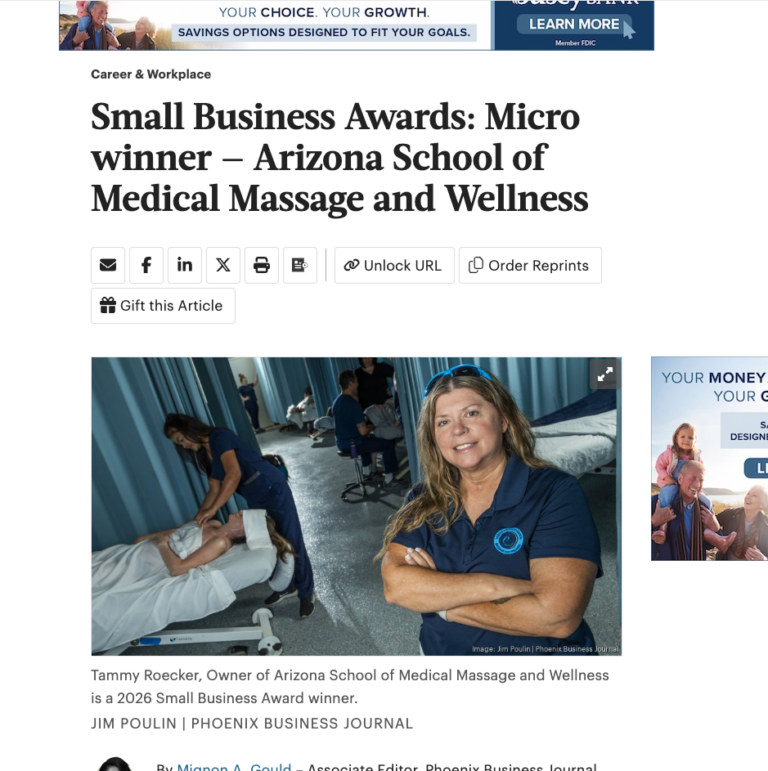
The dream of starting a medical massage school became a reality for Tammy Roecker, President of the Arizona School of Medical Massage and Wellness (ASMMW) in Peoria, Arizona. This visionary institution is dedicated to bridging the gap between massage therapy and the medical healthcare…
How Massage Therapy Saved My Life (Guest Post)
When I became a massage therapist at age 23, I had no idea how impactful this profession would become in my life. Having enrolled at age 22, my life was unstable at that time. ‘Lost soul’ was easily an accurate description for me. I…
Does Accreditation Matter in a Massage Therapist School?
Accreditation, in my opinion, does not improve the quality of massage education. Rather, it means a school can offer you Title IV funding and allow you to receive federal financial aid. Many other massage therapist school owners have debated this as well, and…
How Long Can You Actually Work as a Massage Therapist?
Recently, I was astounded at the length of time that the Licensed Massage Therapists (LMTs) had acquired in the last CE class taught at Arizona School of Medical Massage and Wellness. There wasn’t one person with less than 20 years experience and a few…
What Makes a Good Medical Massage Therapy Program?
First, we need to define “Medical Massage”… What is Medical Massage? Assuredly, it doesn’t mean that we are bestowing medical care to our clients or diagnosing them ourselves! The massage therapist is only educated on those conditions, pathologies, and contraindications. Our clients usually have…
The Importance of an Exciting Career Path You’ll Love
Are you in a boring job with no career path to advancement? Do you wake up each morning eager to go to work? Did you know that there is a healthcare career that you can achieve in only 9 months? Keep reading… Choosing a…
3 Helpful Tools You Need for Managing and Relieving Chronic Pain
Living with chronic pain is a miserable existence. The good news is there are various tools and methods to manage and maybe even relieve your chronic pain. Three helpful tools for managing chronic pain are: 1. Pain tracking apps: Pain tracking apps can help…
5 Benefits of a Career as a Medical Massage Therapist
Are you looking for a new, stable, and rewarding career in healthcare? Guess what? You don’t have to go through years and years of university classes and come out with a huge debt-load. You can train to be a medical massage therapist in…
Medical Massage Therapist Vs Relaxation Massage
More than likely, you have benefited from a relaxation massage at one time or another. However, there is a specialized difference between a general massage therapist and a “medical” massage therapist… What is a Medical Massage Therapist? A medical massage therapist is a licensed…
Can Massage Therapy Help Your Pain? The Science Says YES!
Medical Massage Career
Back pain, neck pain, shoulder pain, chronic pain. It seems like most of us deal with some kind of pain on a regular basis. Did you know that Americans spend over 500 billion dollarseach year to manage or relieve physical pain? But how much of what we’re doing is really effective? And where does massage therapy fit into the picture?
For centuries, cultures around the world have used massage therapy to treat lots of ailments, including pain. The therapeutic effects of massage are often associated with relaxation and relieving muscle tension, but there’s a lot more to it than that. When I first started treating clients for physical pain over thirty years ago, massage was not recognized as a “legitimate” approach for dealing with pain. But I asked lots of questions of seasoned therapists, devoured all the information I could find, and ventured forward. As I slowly developed my own massage protocols, the treatments I provided were working, and my clients were thrilled. At that time, we didn’t have the detailed scientific information explaining why or how massage was helping, and I didn’t know many people who were interested in those details–most people just wanted to feel better! But over the past several decades, science has recognized the physiological mechanisms that explain how massage can help manage pain, and it’s fascinating!
What Does Massage Therapy Do?
One of the primary mechanisms by which massage works is through the nervous system. Massage therapy involves the manipulation of soft tissues—primarily muscles, tendons, ligaments, and fascia. When we apply pressure, whether gentle or firm, we affect the body’s nervous system, circulation, and lymphatic system in ways that relieve pain.
Here in Phoenix, Arizona, we have the great benefit of learning from Dr. Ross Turchaninov, founder of the Science of Massage Institute. Dr. Ross has devoted his career to studying massage and has pioneered volumes of research on how it affects the body’s physiology. He’s shown how massage triggers sensory receptors in the skin and muscles that send signals to the brain. This sensory input can disrupt pain signals by “closing the gate” on them, known as the gate control theory of pain. This theory suggests that non-painful stimuli, such as massage, can block or reduce the transmission of painful sensations. Of course, this leads to pain relief and can be effective in both acute and chronic situations.
Beyond blocking pain signals, massage also stimulates the release of endorphins, the body’s natural painkillers. By triggering endorphin release, massage has an analgesic effect. This endorphin release gives a person the overall feeling of well-being. This is a key reason people often report a decrease in pain and improved mood following their massage.
Impact on Chronic Pain Conditions
Massage therapy has also shown promise in the treatment of chronic pain conditions, such as fibromyalgia, arthritis, and sciatica. Studies have demonstrated that regular massage can reduce pain, improve sleep quality, and enhance overall quality of life for individuals with chronic pain. In the case of fibromyalgia, for example, massage has been shown to reduce the severity of pain and improve function by decreasing muscle stiffness and promoting better sleep.
Massage therapy helps to manage inflammation, a common factor in many chronic pain conditions. By improving circulation and reducing stress, massage helps to regulate the inflammatory response in the body, potentially alleviating pain associated with inflammation, such as in the case of rheumatoid arthritis.
A 2021 study published in the Oxford Academic Pain Medicine journal showed significant improvement in multiple areas for chronic pain patients, along with a decreased need for opioid use to manage their pain.[1]
The American Massage Therapy Association (AMTA) is also a leader in the field of researching the effects of massage for pain management, integrating massage into managed care, and reducing opioid use among chronic pain patients.[2]
Mainstream Medicine and Massage
Research regarding the effectiveness of massage for pain relief has also been done in mainstream medical circles. In a low back pain study dated as far back as 2011, The American College of Physicians reported the following:
“We found that patients receiving massage were twice as likely as those receiving usual care to report significant improvements in both their pain and function,” said Dr. Daniel Cherkin, Director of Group Health Research Institute and lead author of the study. “After 10 weeks, about two-thirds of those receiving massage improved substantially, versus only about one-third in the usual care group.”
In addition to improvements in pain and mobility, patients also reported a reduction in the use of non-steroidal anti-inflammatory medications after massage.[3]
It’s studies like these that have opened the eyes of the public a bit more to see that massage isn’t just a luxury; it’s a viable treatment option that can have tremendous benefits that other treatment modalities do not offer.
Effects on Muscle Tension and Flexibility
Of course, most people are familiar with massage’s ability to reduce muscle tension, a very common cause of pain. Muscle tension pain is often the culprit of headaches, neck pain, back pain, and even fibromyalgia. When muscles are abnormally contracted, they can restrict blood flow and cause discomfort or pain. Massage works by manipulating the muscles and fascia and improving circulation to affected areas.
Why is blood flow so important? Good circulation helps deliver oxygen and nutrients to the muscles, which aids in the removal of metabolic waste products, such as lactic acid, that can lead to soreness. Improved circulation can also reduce inflammation of muscle injuries, which helps to reduce pain and speed up healing.
Reducing Stress and Promoting Relaxation
It’s easy to discount stress, as most people “push through it,” or so they think! In fact, stress is a major contributor to both acute and chronic pain. It can exacerbate all kinds of conditions, from headaches to digestive disorders. But massage can help here, too! Massage has been proven to reduce stress by triggering the parasympathetic nervous system (the “rest and digest” system). This system counteracts the “fight or flight” response triggered by stress, reducing heart rate, lowering blood pressure, and promoting a general sense of calm and relaxation.
Conclusion
Pain is complex and pain management is often complex, too. Thankfully, because massage has been proven effective in treating pain, massage therapists can be found on multi-disciplinary treatment teams these days. As massage therapists, we’ve come a long way in this regard, but we still have a long way to go to achieve full acceptance among more traditional treatment teams. This is where quality education comes in. When massage therapists show up as competent and capable medical professionals, offering solutions and collaboration, we elevate the standards in our field and open doors to being more widely accepted in the medical world. And don’t forget the result everyone is looking for–we are able to relieve more people’s pain!
To learn more about medical massage training, contact us at ASMMW!
[1] https://academic.oup.com/painmedicine/article/22/1/181/6128746?login=false
[2] https://www.amtamassage.org/resources/massage-and-health/pain-relief/
[3] https://www.acponline.org/acp-newsroom/massage-more-effective-than-usual-care-for-treating-chronic-low-back-pain
If you’re interested in enrolling at ASMMW, to become a Licensed Massage Therapist, with a Specialty in Medical Massage and Wellness, the next step is to contact us for a tour.